

Supplements, Balancers or Complete Feeds – What Does Your Horse Actually Need?
If there’s one thing that fills horse owners with doubt, it’s feeding. We all want to do the best for our horses, but with shelves full of supplements, balancers and complete feeds – all promising shiny coats, strong hooves and perfect condition, it’s no wonder feeding can feel a bit overwhelming.
The good news? Once you break each option down into what it actually does, it all starts to make sense. So let’s chat through the three big players: vitamin and mineral supplements, feed balancers, and complete feeds – what they are, how they differ, and how to work out which one your horse really needs.
First things first: forage is the star of the show
Before we get anywhere near a feed scoop, the foundation of every horse’s diet should be forage, grass, hay or haylage. Ideally, forage makes up at least 80 percent of what your horse eats. Once that box is ticked, we can look at what, if anything, they need on top.
A nice way to think of it is:
- Forage keeps them alive,
- The extras help fine-tune the diet depending on how much energy, protein and micronutrient support your individual horse needs.
Vitamin and Mineral Supplements
The simplest option – low calories, essential nutrients
A vitamin and mineral supplement is exactly what it says on the tin: a top-up of the essential micronutrients your horse might be missing when living on a forage-only diet.
These supplements:
- Contain minimal calories
- Don’t provide extra protein
- Are usually powdered or pelleted and fed in small amounts
Ideal for:
Good doers, native types, horses living out on decent grass, or anyone who holds weight easily and simply doesn’t need the extra calories that come with a bucket feed.
Why choose a vitamin/mineral supplement?
If your horse looks at a blade of grass and gains a dress size, this is often the best option. They get the vitamins and minerals they need to stay healthy, without you having to heap unnecessary calories into them just to deliver those nutrients.
If your horse is already in good weight and doesn’t need extra energy or protein, this is the most economical and straightforward choice.
Feed Balancers
More than a supplement – but not a full-on bucket feed either
A feed balancer is like a vitamin/mineral supplement with added muscle and digestive support. It still comes in a small, concentrated dose, but it offers more than just micronutrients.
Balancers typically contain:
- High-quality protein (especially essential amino acids like lysine)
- Vitamins and minerals
- Digestive support such as prebiotics and probiotics
- Fibre-based carriers
- Low calories
Ideal for:
Horses who maintain weight easily but would benefit from quality protein to help build topline and support muscle, hoof health, coat quality and overall wellbeing. Also a great option for horses with tricky digestion or who struggle with loose droppings, stressy tummies or changes in forage.
When a balancer is better than a simple supplement:
- Your horse looks “okay” but could have better topline
- They have poor hoof quality
- Their coat looks dull going into or coming out of winter
- They’re young and still developing
- They’ve had a period off work and are coming back into light–moderate work
A balancer gives the nutrients and building blocks for muscle development without piling on unwanted calories. It’s a great halfway house between minimal feeding and full bucket feeds.
Complete Feeds
Everything in one feed – calories, protein, vitamins and minerals
Complete feeds are designed to be fed as the main part of the diet alongside forage, and they’re formulated to meet the full nutritional needs of a specific type of horse. You’ll see complete feeds marketed for performance horses, seniors, breeding stock, youngsters and so on.
These feeds contain:
- A much higher calorie level
- Significant protein
- Vitamins and minerals
- Fibre and/oil depending on the formulation
Ideal for:
Horses who need extra calories
- Those in heavy work
- Poor doers who struggle to hold weight
- Older horses who can’t chew forage well
- Horses with limited access to decent forage
A complete feed can even act as the sole diet (alongside a bit of forage if appropriate), which is invaluable for horses with dental issues or those unable to eat enough hay.
But here’s the catch:
A complete feed only delivers the full nutrition it promises if it’s fed at the manufacturer’s recommended rate. Many horse owners feed a scoop or two “because the bag said so”, but that amount often falls far below what’s needed to meet vitamin and mineral requirements.
Which brings us neatly to one of the most common feeding mistakes…
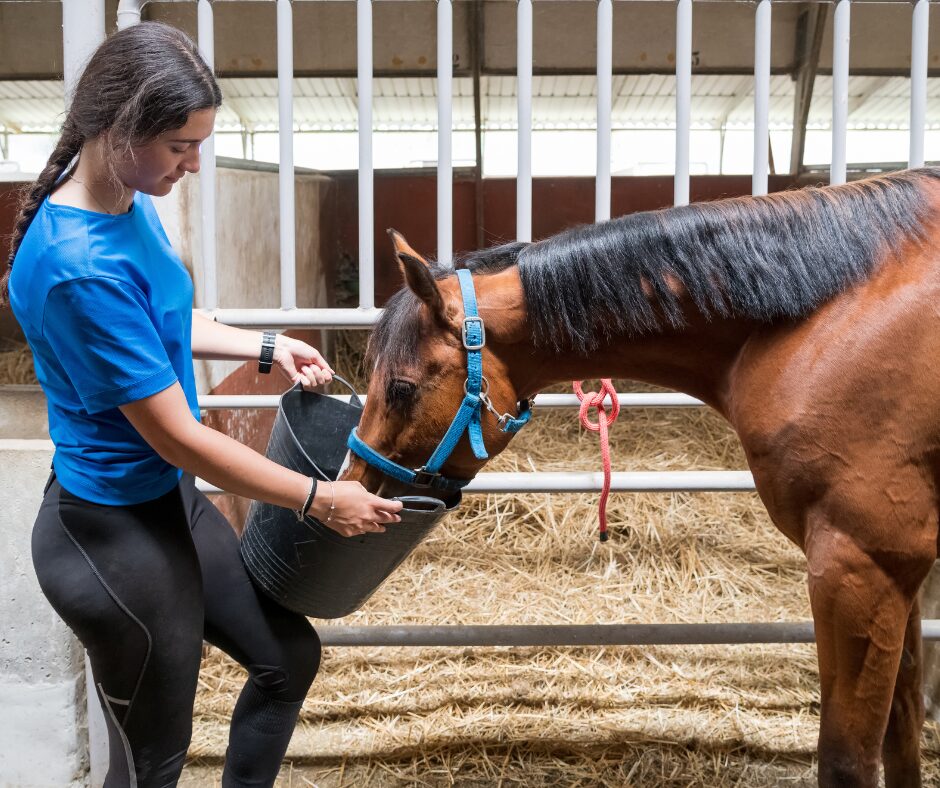
If you feed less than the recommended amount of a complete feed…
…you’re unintentionally underfeeding vitamins and minerals.
Manufacturers balance their feeds assuming your horse will eat the full recommended amount. So if you’re feeding half the amount to prevent weight gain, you’re also feeding half the nutrition.
The simple fix?
Add a balancer or vitamin/mineral supplement to ensure your horse still gets everything they need nutritionally without the extra calories.
This is especially important for:
- Horses who go fizzy on full rations
- Good doers in light work
- Horses prone to weight gain on calorie-dense feeds
Which option is best for your horse?
Here’s a quick summary to help guide your decision.
Choose a vitamin & mineral supplement if:
- Your horse maintains weight very easily
- They live mostly on good grass or hay
- They don’t need extra protein or digestive support
- You’re trying to keep calories as low as possible
Choose a feed balancer if:
- Your horse holds weight well but needs better muscle tone
- You want to support hoof quality or topline
- They’d benefit from digestive support
- You want more than a supplement but without adding extra calories
Choose a complete feed if:
- Your horse is in hard work
- They’re underweight or a classic “poor doer”
- They need extra energy, protein and nutrients all in one
- They’re older or have dental issues and struggle with forage
- Access to quality hay or grass is limited
Remember: complete feeds only “work” when fed at the full recommended rate. If you need to feed less for weight control, pair them with a balancer or supplement.
The bottom line
Forage is always the main event. Everything else is there to support it – and the best choice depends on your horse’s workload, weight, condition and general health.
If they’re an easy keeper, a simple supplement or a balancer is often enough. If they need top-tier support for muscle, performance or weight gain, a complete feed might be the answer.
And of course, if you’re ever unsure, your vet or an equine nutritionist can help tailor a plan specifically to your horse.